Showing posts with label poetry. Show all posts

Saturday, November 7, 2015

Knopf 100--day 20


73.  You know how you hear stories about Barbara Walters being a fierce and possibly a difficult boss? Read Audition and you’ll understand that she’s earned the right to be demanding, and, well, whatever the hell she wants to be. Yeah, she had to put up with Harry Reasoner, so she get’s to do whatever she wants. Forever. Actually the torment Walters put up with at The Evening News is worth the price of the book. Walters is a pioneer of the highest order, she had to put up with a ton of shit so the next generation wouldn’t have to. Oh, she got some pretty good interviews along the way as well: Fidel Castro, Boris Yeltsin, The Shah of Iran, Mohammad Reza Pahlavi, Margaret Thatcher, Vaclav Havel, Jiang Zemin, and of course…she asked Katherine Hepburn about being a tree (she would be an oak).


74.  So I felt a little guilty reading The Selected Letters of Willa Cather. It’s a huge collection and it took me nearly the entire summer to finish the book. And to make matters worse, Cather mentions that her letters are private within the letters themselves (so guilty), and more than once asked that her letters be destroyed. Ugh,  the guilt. I know, but the thing is, its just one of the best collections of letters I’ve ever read. Cather comes to life in the same way Flannery O’Connor came into full view in Habit of Being: Letters of Flannery O’Connor. They were both kind, funny, generous, and had their mind on their money and their money on their mind. Well, the ladies took care of business. Don't read the Willa Cather letters to look for clues to her sexuality, or gossip. Why are we still talking about it? What isn't clear about it? She was inducted into the National Cowgirl Hall of Fame, that's like old timey softball cred!  

75.  Diane Arbus was ahead of her time; she was pigeonholed as a strange photographer who took pictures of "freaks." Now we know she was actually capturing  people forced to live on the fringes of society, often shamed and ridiculed. Arbus who suffered from depression her entire life (as did her mother) would eventually kill herself, which would then catapult her to worldwide fame.  What Patricia Bosworth does so well in Diane Arbus: A Biography is temper the odd myths vs the truth. She digs deep and interviews dozens of family, friends and peers (the list is impressive and nearly all are dead now), giving Arbus a full biography that she deserves; if you've admired her photographs don't skip this fantastic book.


76.  I've only read two Raymond Carver books (impressive, right?) the first is of course the story What We Talk About When We Talk About Love and the second is All of Us: Collected Poems, which I purchased about ten years ago at a garage sale for twenty five cents (she was asking fifty cents per book, but let's just say I'm a pretty savvy book dealer and knew I could get it for half that. Plus it was chewed up a bit on the corner and smelled faintly of wet dog). I fell in love with this book immediately and purchased a less disgusting copy later the same week. Be different, read Carvers stories some other time, buy this 400 plus page tome. Carver loved poetry, he loved being a poet, and he would think you were really swell if you bought this in his memory. Don't be cheap, pay full price.

Tuesday, November 3, 2015

Knopf 100--Day 16


57. If you asked twenty people at Random House to name their top twenty favorite books, I bet over half them place Plainsong by Kent Haruf on that list. It's a deceptively simple novel about the fictional town of Holt, Colorado, and it’s inhabitants. Through a few characters--Maggie, Victoria and the McPheron brothers, --Haruf moves you through this small town. Occasionally you will hear someone describe reading a book and becoming so engrossed that you forget it’s fiction, or you think just for a moment that you know the characters. That’s what Kent Haruf is able to do. He transports you to this lovely town and so expertly writes engaging characters, that you absolutely lose yourself. Plainsong, by the way, is actually a trilogy; it is followed by the Eventide, and Benediction. I envy anyone who hasn't read this trilogy yet, you're in for a really wonderful treat. 

58. "Paper Moon is one of the best movies ever made!" I once had a thirty second conversation with Peter Bogdanovich and that's what I chose to say. I think he was pretty impressed that I didn't shower praise on the obvious masterpiece, The Last Picture Show. Anyway, don't let that play over and over in your head, it's cool. Bogdanovich had a pretty frustrating career as a director actually; I like to blame it on his very odd life choices but we aren't going to talk about that. We are going to talk about the excellent book, Who The Hell's in It: Portraits and Conversations (the Ballantine paperback edition has a slightly different subtitle of Conversations with Hollywood's Legendary Actors). This book was a follow up to conversations with directors, but Bogdanovitch studied under Stella Adler (she's in the book) and was a reporter before he was an actor or a director, so this book really is perfect. Who the hell's in the book? Everyone. Marilyn Monroe, Charlie Chaplin, Lillian Gish, Sidney Poitier, River Phoenix, John Cassavetes, and Audrey Hepburn. I mean, it's a huge list, that's not even half. This book is an absolute must have for movie buffs. If you haven't seen Paper Moon...it's one of the best movies ever made!


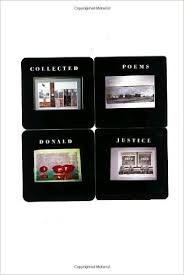
59. What do Rita Dove, Charles Wright, Mark Strand, Jorie Graham, John Irving, and James Tate have in common? That's right! They're all Pulitzer Prize winning poets who were taught by Donald Justice. Well, okay, if you're going to be picky, John Irving isn't a Pulitzer Prize winning poet but he was taught by Justice and clearly adored him (read Hotel New Hampshire). Where to start with Donald Justice is easy--start anywhere: Collected Poems (2004) which was nominated for the National Book Award,  New and Collected Poems (1996) which was nominated for Pulitzer. Justice, by the way, would win his Pulitzer in 1980; you think he's going to let everyone else collect one?  Well, he probably didn't give much thought to these things, he was quiet, thoughtful, and incredibly modest. I will end with one of my favorite Justice poems, "On the Death of Friends in Childhood" which can be found in Collected Poems 


We shall not ever meet them bearded in heaven, 
Nor sunning themselves among the bald of hell; 
If anywhere, in the deserted schoolyard at twilight, 
Forming a ring, perhaps, or joining hands 
In games whose very names we have forgotten. 
Come, memory, let us seek them there in the shadows.


60. Nell Freudenberger came on the writing scene at the ripe old age of 25. She published a phenomenal book of short stories called Lucky Girls, which I loved. She continues the same theme of clashing cultures in her debut novel, The Newlyweds to great success. Amina, a  young woman from Bangladesh, searches for a mate on an international dating website where she meets a lonely man a decade older who pines for a family of his own. An arranged marriage of sorts follows and while this could easily fall into some dead end formula, Freudenberger nails this on every level. 


Tuesday, July 12, 2011

30 Day Book Challenge: Day 8

Day 8: A Book That Scares You

Who needs a book to scare me?  The people who lounge out by the pool at my apartment complex scare me every day.  Between the woman with "Hottie" written in pink sequins across her posterior and Mr. Banana Hammock, it's a horror show of the first order.  Books, well, that's a bit tougher.

Gianna

This question is too vague. What immediately comes to mind is any celebrity book that includes poetry. It could be a biography with an example of what the actor jots down in the middle of the night when he can't sleep, or really just full on "poetry" (looking at you Rosie). I must include musicians on this list..Jewel, stop it. T-Boz (TLC for those of you not cool) absolutely not. Melissa Etheridge...honey just set that shit to music; do not try to pass it off as poetry.

Liz

The Hot Zone by Richard Preston

Let's start with my dislike of monkeys and all primates.  Throw in the killer virus that wipes out up to 90% of the people who contract it and does things like making your eyes bleed and liquefying your internal organs.  Add that the killer monkey virus that can spread to humans came to the US and it could happen again.  Oh, and it's not fiction. The book freaks me out.