Showing posts with label Cormac McCarthy. Show all posts

Monday, November 2, 2015

Knopf 100--Day 15

It seems I'm in a dark book mood today.


53. Tokyo Year Zero by David Peace, originally published in 2007. David Peace is a great mystery writer and this mystery is unlike anything else I've read. It's set the year after World War II ended, in a broken Japan. The country is bankrupt which means that the Tokyo police force is bankrupt. When a killer unleashes horrors on the city, a detective is hot on his trail. What's special, though, is Peace's stream of consciousness writing that captures the underworld terror of the city and its war worn residents. Things like the nagging itch of lice become focal points for the characters and reader.

54. American Prometheus by Kai Bird and Martin J. Sherwin, originally published in 2005. I'm admittedly obsessed with atomic culture and the historic impact of the bomb on the 20th Century. That culture all begins with J. Robert Oppenheimer, the subject of Bird and Sherwin's award winning biography American Prometheus. Here is Oppenheimer's story, from Communist sympathizer to father of the atomic bomb to moral conscience of the nuclear era. Oppenheimer is fascinating because of his scientific genius and ability to lead the Manhattan Project, but he's also intriguing for his affairs, political beliefs, and how the people who revered him after the war ultimately destroyed him several years later. Yes Gianna, I do have a crush on Oppenheimer. I'm not ashamed.

55. In the Cut by Susanna Moore, originally published in 1995. Ooh, creepy, gothic, erotic, serial killer novel! I have to include this book on the list, and I need to grab it before Gianna snatches it away from me. When a woman is murdered in her neighborhood, Franny, an academic with a love of precise language, becomes obsessed with the crime and her darker desires. She begins an affair with the detective on the case, and this book becomes a twist of language, sex, risky behaviors, and distrust.

56. All the Pretty Horses by Cormac McCarthy, originally published in 1992. All the Pretty Horses was my first experience reading Cormac McCarthy, when I "borrowed" a copy off my boyfriend's shelf. I don't know what I was expecting that night, but I doubt I expected to be so sucked into a book that I ignored everything else for the rest of the evening. The story follows John Grady Cole, a 16 year-old kid who, spurred by the death of his grandfather, sets off on horseback. Accompanied by a couple of friends, the boys venture into Mexico and encounter love, bandits, and the desert. This novel deserved the National Book Award that it won.


Sunday, January 6, 2013

New Year, New 30 Day Book Challenge, Day 4

All Three Novels 
Day 4: Favorite Book of Your Favorite Series

Gianna:

All the Pretty Horses
I realized today that I totally blew yesterday's question. When someone says series, my mind always goes to either teen books or fantasy books, neither of which I read. However, I really do have a couple of  favorite series. First, The Border Trilogy by Cormac McCarthy.

The  McCarthy trilogy consists of All the Pretty Horses, The Crossing, and Cities of the Plain. My favorite is the first, maybe because it's the first McCarthy book I had ever read, and I was just blown away. I remember reading this book pretty clearly. I was living in Florida (maybe 1996 or 1997), and I was looking for a book to bring to the beach, saw this sitting on a paperback table and picked it up because....the cover was gorgeous. I know, but let's not start judging now. [Too late.] I went back to the bookstore (Books & Books in Miami) and bought The Crossing (I also picked up Blood Meridian which may actually be my favorite McCarthy book - I can't decide). I think I was making about $10 an hour back in '96, so where I got the money to buy so many books in a week is beyond me. [Petty theft? Prostitution? Blackmail?]

Cities of the Plain 
The Crossing

Of course as I am finishing writing this, it's occurred to me that I also love William Faulkner's Yoknapatawpha County novels (though he set many short stories here as well). Perhaps this is a blog post for another time. Actually, I think both Liz and I love Faulkner so that might be a road trip in the making. Absalom, Absalom! is my favorite by the way. It has a map.

map inside!
Liz:

Ooh, handcuffs!
If we were playing by the rules and going with the favorite book from the series we picked yesterday, I'd be stuck picking Fifty Shades Freed.  Why? Two reasons: the handcuffs on the cover, and that it's the last book (until EL James writes another one).  Ooh!  Reason number three: naughtier sex toys!  (I know this because, while I haven't read the books, I did download the manuscripts at one point so that I could torture people with dramatic passages found through keyword searches, and "anal plug" appears in book three.  You're welcome.)

Since Gianna is breaking the rules, though, I am too.  I'm going with Mary Karr's memoir trilogy, The Liars' Club, Cherry, and Lit.  We've written about Mary Karr quite a bit, and particularly The Liars' Club, which holds a special place for me because it's set in the rural patch of hell where I also grew up.  That said, though, at the moment I think I appreciate the introspection and adult struggles confronted in Lit more. Having read her first two books, I needed to know how the scrapping little East Texas kid became a literature professor and renowned poet.  I needed to know how she survived, and I needed to know that her journey hasn't ended. Lit is equal parts book lover's dream and redemptive addiction story, and Mary Karr's use of language is brilliant.


Monday, March 12, 2012

A Semi-True Conversation between Gianna and Liz

This really happened.

Gianna: We should do a few blog posts about Irish writing for St. Patrick’s Day.

Liz: …Okay.  I am drawing a blank though.  I’m not sure that I can think of many Irish writers.

Gianna:  Sheesh.  Of course you can.  Everyone knows at least a few.

Liz: What about Larry McMurtry?

Gianna: Is he Irish?

Liz: MCMurtry—gotta be Irish.  And in Lonesome Dove Captain Call was born in Ireland, and there were the two Irishman—the one bitten by the snakes and the other one who went to the brothel with Newt.  And Gus’s last name is McCrae.  MC-Crae.  And McMurtry is from the Dublin of Texas, Archer City.

Gianna: That sounds about right.  (Sarcasm?)

Liz: Okay, then there’s Cormac McCarthy. 
Joyce is Irish.

Gianna, reading from the internet:  “He renamed himself ‘Cormac’ after the Irish king.”

Liz: Heh.  There are you kings in Ireland.  Queen Liz rules all.

Gianna: You’re going to get us in trouble.

Liz: What about Joyce?

Gianna: Definitely Irish.

Liz: ….Carol Oates.  Upstate New York is just like Ireland.  Tim O'Brien?  Dr. Phil McGraw?

Gianna: You’re getting pale people confused with Irish people.

Liz: I think I hate you.

Sunday, January 29, 2012

Days of Love...and Lack Thereof, Day 4

Gianna:


I think that if you are making a list of romantic books, as devastating as she can be, you must include at least one Amy Bloom book. My Amy Bloom book is the epic tale Away.
Amy Bloom

Lillian Leyb’s parents, husband, and presumably her three-year-old daughter Sophie were brutally killed in Russia. Lillian escapes from Russia to New York in 1924 where she finds work as a seamstress in a Yiddish theatre. She soon becomes lovers with the lead actor of the troupe and his powerful father. After whispers that her daughter may still be alive and living in Russia, Lillian begins planning her trip back home. With little help, she begins an epic journey across the country: a train to Chicago, then to Washington, culminating with her walk across the Alaskan wilderness to find her daughter.  This novel is incredibly rich with full three-dimensional characters that you won’t be able to forget. Away is one of the most powerful, well-written novels I have read, yet completely accessible. This novel may not be romantic in a Valentine sort of way, but trust me, it is romantic in a bold way.

Side note: Away was inspired by Lillian Alling who attempted to walk home to Russia from New York in 1927. 


Liz:

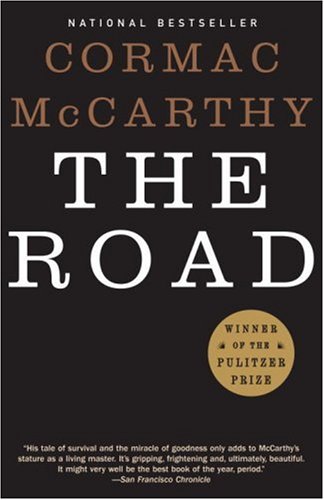
Ah, Cormac McCarthy.  No one tells a love story quite like you.  You're a modern Jane Austen.  Who else could take a story of the bleakest post-apocalyptic world ever written and turn it into a love story?  The Road is full of beautiful writing, charming scenery like that basement full of half-dead zombie people, passionate interactions with roving bands of humans who love romantic dinners of humans (mmm....cannabalism....), and the most wonderful ode to a soda ever written.  Trust me, this novel is great.  At its center are a father and son walking along a road with only a gun and two bullets to save them from true horrors.  In spite of the bleak setting, The Road actually really is an uplifting story of parental love...even if you'll want to use that last bullet on yourself after reading it, it's just that upbeat.

Tuesday, August 30, 2011

30 More Days Book Challenge: Day 21

Day 21:  Favorite Book By a Texan or About Texas

Gianna:

Unlike our good friend (and part-time lover) Liz, I am not a Texan. [And I am not Gianna's part-time lover.] I’ve lived in Austin for over a decade but….Texans are pretty strict so as far as anyone here is concerned, I am a northerner. On that subject, I suspect anything over three drinks and Liz’s East Texas accent makes a big appearance. [Wouldn't you like to know.]


You really cannot talk about Texas literature without mentioning The Gay Place by Billy Lee Brammer. This novel (it is actually made up of three novellas) captures Texas politics in all its glory – think All the Kings Men with an LBJ-like character at the center. The Gay Place is a true classic that would inspire a generation of writers.

I thought this favorite would be easy, a slam dunk. But then I started putting real thought into it – I mean when you have to choose between Larry McMurtry and Cormac McCarthy (the battle of the Mc’s). I finally decided on The Border Trilogy by McCarthy over The Last Picture Show because I am going to write about McMurtry’s book later.

All the Pretty Horses was the first Cormac book I read, and if you’ve read him then you understand when I tell you I immediately read pretty much everything he had written to that point. The plot of Horses is filled with romanticism, which is very different than his previous or most recent work (although Horses certainly is dark as well). In 1950’s Texas a teenager learns that after the death of his grandfather their ranch will be sold. Rather than move into town, he convinces his best friend to travel with him via horseback to Mexico where they attempt to get work as cowboys. Things don’t go as planned.

Please put the movie out of your head – Cormac McCarthy is one of a handful of truly great American writers. I think it is safe to say that you will never find him on a list of overrated writers. I hope you will give All the Pretty Horses a chance; I feel pretty confident that you will go on to read The Crossing and Cities of the Plain to complete The Border Trilogy.

Liz:
 
Yes, I was born in Texas, but most Texans seem to think I'm from New England or Midwest.  I don't correct them.  I'm not a rah-rah "Texas is the greatest place in the universe" type of person.  And for the record, this topic was Gianna's idea.  That said, I have read a number of Texas books, both fiction and non. Gianna and I had decided on the topic in advance and I had a book in my head that I planned to select...and then I read what Gianna emailed me and realized that for the first time in this challenge we'd picked the same book: All the Pretty Horses
 
I stumbled onto McCarthy.  My boyfriend at the time read lots of Texas-themed books, but mostly the naturalists.  I found myself over at his apartment one night without reading material, and one of the few novels he owned that I hadn't yet read was All the Pretty Horses.  I picked it up, and I kept reading.  (By the way, one of the things we shared, the two of us, was that we could spend an evening reading in the same room.  This is a must for me--somehow I'm guessing that the convicts Gianna suggests for future Liz companions wouldn't be able to be still in a room and read.  Or, you know, in general, be able to read.)  This is a literary adventure story of the first order. 
 
I do think that West Texas and East Texas books are two distinct regional genres, however, and for that reason I would also like to give a shout-out to Rodney Crowell's Chinaberry Sidewalks.  Crowell, best known for his songwriting and country music career, wrote a brilliant, poetic memoir about growing up in '50's Houston and East Texas.  Hurricanes, family violence, music, and coming of age--this is a great read and a great addition to the Texas canon.  I can't stress enough how strong the writing is; Crowell is a wordsmith.  He's also the type of guy with whom you want to have drinks and then just listen to him spin stories.

Saturday, October 2, 2010

Betting on Nobel

This year's Nobel Prize for Literature will be announced on Thursday and the various book industry news venues are posting almost daily updates speculating on which esteemed writer might win this year's prize.  While I have no doubt that every source is, well, full of it, I do love the annual Nobel Prize build-up because it focuses attention on so many great authors.  And leave it to the Brits to take pleasure in betting on who'll win a literary award.  The British bookmaker Ladbrokes posts the top odds for the world's current literary giants (http://www.ladbrokes.com/lbr_sports?action=go_generic_link&level=EVENT&key=214493738&category=SPECIALS&subtypes=&default_sort=&tab=undefined). 

It's a fascinating list, but really, does the Nobel Prize for Literature mean anything?  I do think that award recipients are worthy, and considering my career I'm always in favor of any event that will generate book sales.  But how does one go about selecting the pinnacle of lifetime literary achievement each year, the one writer whose life work outshines the other six billion people on the planet?  It can't be done, and so the award tends to rotate from country to country, genre to genre, honored as much for the political climate of the year as for the author's body of work.  When Harold Pinter won the prize in 2005, speculation was that the outrage over the US invasion of Iraq and the Bush administration's treatment of detainees kept the selection committee from picking the first American since Toni Morrison in 1993.  It's a weird prize that lends itself to stereotyping, a single individual representing a whole group of people, a whole country.  There's the Chinese guy, the Holocaust survivor, the Irish poet, the South African, the Gulag survivor, the African-American woman...it's a little insulting to the talented writers representing their demographics, but the award also calls attention to important works.  Is it a good thing?  Is it wrong?  Maybe it just is.

So who are the bookies picking this year?  The popular choice is for a poet to win since the last decade or so of winners have been novelists or playwrights.  The favorite right now is Tomas Transtromer at 4/1, followed by Adam Zagajewski, Adonis, and Ko Un all at 8/1.  Generally I don't read much poetry and am only familiar with the work of Adonis.  For me the list becomes far more interesting with the 11/1 writer, Haruki Murakami, and then a cluster of my favorite writers hovering at 18/1.  The odds go all the way to the dark horse popular "poet," Bob Dylan, at 150/1.  Here are some highlights from the list of the world's greatest living writers, authors worth reading regardless of whether they ever actually go to Sweden.

  • 11/1: Haruki Murakami.  Murakami is the best known Japanese writer in America, a post-modern writer who draws heavily from Western culture and music.  He's also an avid runner and recently completed his first ultra-marathon.  What to read: The Wind-Up Bird Chronicle, which infuses music, the fantastic, and violence around the story of a seemingly boring man whose cat runs away, kicking off a chain of event.s  Also, What I Talk About When I Talk About Running, Murakami's nonfiction account of his life as a marathoner and triathlete.
  • 18/1: A. S. Byatt.  Antonia Byatt is a British writer who won the Booker Prize for Possession.  Her most recent novel, The Children's Book, was one of my favorite books of 2009, a rich, historical novel revolving around a writer and her seven children in turn of the century rural England.  It's a book about family, secrets, love, and the loss of innocence children--and nations--experience as they mature, culminating in the outbreak of World War I. 
  • 18/1: Joyce Carol Oates.  Probably the most prolific writer of literary fiction alive today, Oates not only has cranked out dozens of books, essays, and short stories, they almost all been high quality.  She isn't afraid of violence and regularly pursues the darker corners of the "American Dream."  She won the National Book Award for her novel them (and should have won for Blonde, a finalist four decades later).  Oates also wrote my favorite short story, "Where Are You Going, Where Have You Been?"  Check out We Were the Mulvaneys, a moving, dark story about the disintegration of a "perfect" family after the only daughter is attacked one night and her father can't cope with the violation of his daughter.  I also love Blonde, Oates's fictional life of Marilyn Monroe; I had no interest in Monroe at all until reading this book.  The same is true for The Falls, a novel that begins with a new husband committing suicide on his honeymoon at Niagara Falls, a tourist site which also didn't interest me until JCO immersed me in her story.
  • 18/1: Margaret Atwood.  I admit that I love Canada and therefore love Margaret Atwood all the more.  Atwood writes great literary fiction, great historical fiction, great speculative fiction set in a dystopian future.  She is known for her social conscience as well as her humor and lately has become an avid Twitter user (Tweeter?  Twitterer?).  Atwood won the Booker Prize for The Blind Assassin in 2000 and The Handmaid's Tale is required reading in many high schools and universities.  More recently Atwood has written two linked near-future novels, Oryx & Crake and The Year of the Flood, that predict apocalyptic catastrophe with the destruction of the environment and rampant genetic engineering.
  • 20/1: Cormac McCarthy.  He's dark, he's twisted, he's reclusive, he's Cormac McCarthy.  McCarthy won the Pulitzer Prize for his post-apocalyptic novel The Road, and literary critic Harold Bloom called his novel Blood Meridian "the greatest single book since Faulkner's As I Lay Dying."  Two great places to start for readers wanting to try McCarthy--No Country For Old Men, which inspired the Academy Award-winning movie, and All the Pretty Horses, which won the National Book Award.  Both books are superb examples of McCarthy's writing style but aren't quite as bleak as some of his other books.
  • 25/1: Maya Angelou.  Poet and memoirist (and cookbook writer) Maya Angelou is best known for her first memoir, I Know Why the Caged Bird Sings, her story of growing up in rural Arkansas.  The book is required reading for many grade school students and I feel like it's sometimes dismissed because of the school-aged audience.  The best memoirs, though, seem to come from poets--Mary Karr, Nick Flynn, and also the first of the confessional memoirs, Caged Bird.  Angelou also composed and read a poem at Bill Clinton's first inauguration and is pals with Oprah.
  • 45/1: Chinua Achebe.  The Nigerian born Achebe is best known for his first novel, Things Fall Apart.  The book, about a tribal man whose life is complicated when Christian missionaries arrive in his village, has sold over 8 millions copies and is the most translated work of African fiction in the world.
  • 50/1: Ian McEwan.  A crafter of fine characters and stories, McEwan achieved a new level of fame after the release of the movie version of his novel Atonement struck box office gold.  A war story and love story, Atonement centers around a girl misinterpreting an encounter she observes between her older sister and a servant's son, leading to the young man's arrest.  When war erupts across Europe, he leaves to fight.  McEwan also won the Booker Prize for Amsterdam, and his most recent book is a humorous, amoral romp through global climate change called Solar.
  • 66/1: Michael Ondaatje.  Ondaatje, another one of my Canadian crushes, won the Booker Prize for The English Patient, which was later made into the Oscar-winning film.  The book is a sweeping love story set before and during World War II, and like most instances, the book is even better than the movie.
  • 75/1: Atiq Rahimi.  I admit that I wasn't really familiar with Rahimi until last year, but one of the cool aspects of the Nobel Prize is that it does have the potential to expose audiences to great literature from around the world.  Rahimi is definitely a great writer.  Born in Afghanistan, Rahimi lives and writes in France now, where he works as both a novelist and film-maker.  In 2008, Rahimi's novel The Patience Stone won the Prix Goncourt, France's most prestigious literary award.  The book tells the story of an Afghani woman caring for her wounded husband who lies comatose in a bed as war rages in the streets outside.  She's angry at her husband for deserting her via gunshot wound and slowly begins to tell him about her life for the first time, releasing her frustrations at her life, marriage, and the constraints placed on women in the Taliban-governed country.
  • 100/1: Peter Carey.  Australian novelist Peter Carey is one of the most gifted storytellers writing these days.  He's twice won the Booker Prize, for Oscar & Lucinda in 1988 and The True History of the Kelly Gang in 2001.  His latest book, a historical novel based on the real-life social critic Alexis de Tocqueville, is entitled Parrot and Olivier in America, and it too is shortlisted for the Booker Prize.
Who will win?  I myself think that it's about time a Canadian wins, so I'm crossing my fingers for Atwood, Ondaatje, or short story writer Alice Munro (also at 18/1 odds).  Unlike other prizes such as the National Book Award or Man Booker Prize, we won't have an inkling of the shortlisted books in advance.  In fact, the Nobel Prize doesn't reveal  finalists until 50 years after the presentation of the award.  It really could almost anyone walking away with the 10 million Swedish kroner and medal.

Sunday, August 22, 2010

The End of the World As I Know It


I confess that I have a fondness for apocalyptic and dystopian fiction. The creepier the end-world scenario, the better--and what makes them creepy? The creepiest novels are the ones that seem eerily possible. Twenty years ago, Margaret Atwood predicted that a hyper-fundamentalist theocracy would begin to brainwash the country, subjugating women. And today, driving to Mississippi, I eavesdropped on a conversation at a convenience store that involved a woman telling a man that the reason a mutual acquaintance was still single was "'Cause she's lazy and she won't cook. How's she ever going to get a man if she can't cook?" I am pretty sure that religious cults insist that women know how to cook...writes the single woman who absolutely refuses to spend her free time in the kitchen. Pot? Kettle.

Anyway, there's a lot to fear in the near future, and here are a few of my favorite alternative, probably bleak, novels.

NEVER LET ME GO--Kazuo Ishiguro's terrific novel about exceptional teens raised in a "special" school will soon debut nationwide as the new film starrng Kiera Knightley. Ishiguro is a Booker Prize-winning writer, the story rivals all the great love sagas of literature, and then there's the creepy truth about these kids' lives and their special value to society. I can't wait for the movie.


CLOUD ATLAS--If you asked me what my favorite book of the decade was, it would be this experimental novel by the brilliant David Mitchell. CLOUD ATLAS ingeniously blends together six separate stories, from a Patrick O'Brien-esque naval tale to a "China Symdrome" nuclear threat to a dystopian future akin to Kevin Costner's "Waterworld," all centering on the theme of free will and independence. This book reaffirmed my desire to stay in the book business when I was considering graduate school. Books are just more fun.

THE YEAR OF THE FLOOD--No one manages to blend literary prestige with speculative fiction like Margaret Atwood, and THE YEAR OF THE FLOOD is her most recent stroll into the near future. The events of YEAR OF THE FLOOD are the same as those in ORYX & CRAKE, both book looking at what will happen if we continue to destroy the environment and tamper with potentially dangerous genetic engineering of the food supply. Killer viruses, a hippie gardening cult, and strippers make THE YEAR OF THE FLOOD highly entertaining as well as scary.

THE UNIT--Swedish authors are hot right now, with the Stieg Larsson trilogy dominating all of the top spots on the NYT Bestseller List, but don't think that Stieg is the only Swedish author out there. THE UNIT, by Ninni Holmqvist, is set in the near future and centers around Dorrit, a woman-of-a-certain-age who, upon turning 50, moves into a retirement community of sorts with other aging, childless singles. It's like a seniors mixer/party in a dorm facility, with classes and dances...and organ harvesting. THE UNIT questions a person's worth beyond one's ability to reproduce. Maybe if Dorrit had learned to cook and moved to Mississippi she'd have found a man....

THE ROAD--Cormac McCarthy's novel of a father and son trying to survive after global catastrophe, with cannibals roaming around and horrors around every corner, received a big push when Oprah picked it for her book group a few years ago. It's a bleak book to be sure, but also a moving portrait of love in the face of adversity.

THINGS WE DIDN'T SEE COMING--How could you not be curious about a book written by a guy who used to be a psychiatric nurse and then moved to Australia? These linked stories assume that the global shutdown foretold with Y2K does transpire and the world is thrown into chaos and famine. It could have happened.

THE RAPTURE--This creepy thriller centers around the daughter of religious fundamentalists who predicts the future...a future that involves 1,000 foot tidal waves destroying the earth. The cause of the waves? An offshore oil rig disturbs the dangerously volatile frozen methane at the bottom of the ocean, creating a massive explosion. You know, sort of like the recent gulf oil spill.

All of these books open lots of room for discussion, making them ideal for book groups.