Tuesday, October 19, 2010

Texas Book Festival 2010: Doing THE WAVE with Susan Casey

Even though my beloved author crush Colson Whitehead did not propose to me last year (in his defense, he wasn't aware that I was expecting a ring because he didn't know who I was), I opted not blame the Texas Book Festival for my continuing lack of a social life or spousal bliss.  Sigh.  The book festival occurred this weekend, the fifteenth anniversary of the book lover's dream event, and I taped together my broken heart and drove to Austin for the fun.

The first event I attended featured Susan Casey, executive editor of O The Oprah Magazine and author of a new book entitled The Wave.  I read The Wave months ago when preparing for a March sales conference, but the scenes from the book have stuck with me--stories of huge cargo ships swallowed by the sea, a fishing boat in Alaska that survived a 1,700 foot wave (!!), and, incredibly, the surfers who try to ride the monsters.  I was not a fan of the ocean before reading the book (an encounter with a jellyfish when I was 12 and my inability to mentally block the idea that I'm swimming in fish poop killed any desire I might have possessed to swim in the beautiful briny sea), but Casey's book offered a new dimension to my ocean issues.  She manages to capture the potential destruction and terror of these huge waves without losing her undeniable love for the water.  She knows that the awesome force of waves could tear apart the strongest structures--the waves contain massive amounts of energy--and yet she cannot resist the opportunity to follow the extreme surfers like Laird Hamilton as they track and ride 80 foot waves. 

Susan Casey describes monster waves.
David Grann, author of The Lost City of Z and The Devil and Sherlock Holmes interviewed Casey for her Book Fest event, and at one point he asked her what she wouldn't do, her limits in immersing herself in her research topic.  She never reached a point where she backed away from an adventure, though.  She swam with Laird Hamilton around Jaws, the wave break outside Hamilton's home in Maui, and she actually rode down the face of several monster waves with Hamilton on a jet ski.  She already knew the threat--the first big surfing day she covered for the book ended with a couple of surfers dying--but she's passionate about the ocean and her story. 

On top of being a fascinating speaker, Susan Casey proved to be a great sport, generous with her time and supporters.  After signing books for the Texas Book Festival crowd, she walked over to BookPeople, the Austin independent bookstore ten blocks away, in order to sign books and talk to booksellers.  She even hung around a bit to shop, buying copies of the Gillian Flynn thrillers Sharp Objects and Dark Places, great choices in my humble, Random House-pimping, opinion. 

There are always the horror stories about authors who treat readers and booksellers poorly.  I certainly have milked the drama of a celebrity author's crazy wife over the course of the last year (the woman alternately thought I was the driver even though I introduced myself, and then the person who should hold her purse while she took her time in the restroom, and the five hours I spent in her presence have scarred my fragile psyche) and have my own list of unpleasant personalities *coughDr.Philcough*.  Alternately I keep a list of the great authors, the ones who appreciate that their writing is meaningful for their readers and are grateful, humble.  Susan Casey is the kind of writer easy to celebrate, the kind for whom I cheer when I see The Wave on the bestseller lists.  Meeting her and hearing her speak about killer waves was a great way to start my Book Fest trip this year.  She's cool.  Oh, and her book?  PERFECT for fans of Born to Run or Into Thin Air, a great gift for the holiday season. 

Thursday, October 7, 2010

The Long Way Home

From Gianna:

It is a question booksellers and book lovers ask each other often, “What book has changed your life?” The answer, of course, changes with age, with what we’ve read, and with life experience. Occasionally, or maybe not even that often, there is a book that you want to push from your mind and can’t seem to move from your nightstand at the same time. For me that book has been Gail Caldwell’s Let’s Take the Long Way Home. It is subtitled “A Memoir of Friendship” which is pretty innocuous at first glance. A memoir of friendship to be sure, but the level of this friendship is spiritual and as committed as the best of marriages. It is the gorgeous story of Gail’s friendship with fellow writer Caroline Knapp (author of the two classics: Drinking A Love Story and Pack of Two ). The book begins with these lines: “It’s an old , old story: I had a friend and we shared everything, and then she died and so we shared that , too.” As women we are bombarded with false reports and bullshit polls that women don’t get along, and of course the media loves to portray us with our “claws” out – after each others' men or jobs...or are we simply jealous of each others' boobs? It is such a lie, such a crappy lie, but worrisome that some of us are buying into it. Women do have lifelong, meaningful, important friendships; we always have. Gail and Carol’s story is just one of many, as is mine.
I’ve lived with this book for the better part of two years now; I can not shake it, but it has weighed most heavily on my mind this past month.

I have a very close friend; she in fact was my first girlfriend. I was 18 years old when I met her; she told me I wasn’t funny and of course…I was smitten. About four years ago she was diagnosed with stage IV breast cancer. And as that diagnosis does – it takes your breath away – but we live in a time where this is often called a manageable disease. And it is.  It’s not fun, but it is a constant battle. And then like metastasized breast cancer does…that little fucker spreads. Sometimes to the liver, lungs, bones, or the brain among a zillion other nooks and crannies, and for us we got bones. My friend took it in stride, fought on, chemo and radiation ,and just carried on. Recently tumors were found in her brain. So then came radiation on her entire brain, and more chemo of course. Things looked good, the doctors were still talking managed care, so we started planning a road trip from her home in Florida to Las Vegas, stopping here in Austin for a few days to rest. My friend has a small gambling issue – she won’t admit it – but, you know, it’s all she loves to do anymore.  She’s no good at it and I’ve never actually known her to win…but that’s another story. Anyway, we began planning. Then, just a few weeks ago, her Johnny-on-the-spot doctor didn’t like the way she was walking, ordered a CAT scan, and there you have it …more tumors.

I flew out again as soon as I could – our mutual best friend had to leave for a work trip so I would be in charge of caring for her. My friend is a lot to be in charge of without cancer by the way – she is a bit of trouble; add cancer to the mix and I had my hands full. We had scheduled an MRI and I have never been as nervous sitting in that doctor's office with her and our mutual friend (who had come back from her business trip) waiting for the results. We were positive, however; we thought from the CAT scan that we were dealing with one very treatable tumor. Turns out, CAT scans are so inferior to MRI’s that it shocked us when the sheer number of actual brain tumors was revealed. Numerous very small tumors all over her brain, and a few larger (but still small) tumors were also in the mix and these would be our focus. So we march on.

Today my friend is headed in for her fourth day in a row of Gamma Knife radiation – it's what it sounds like, extremely precise – you have a mask made of your face and are pinned down while you get zapped. I was with her when her mask was made and I at that moment thought How does she doe this – day in – day out? How? Anyway, so day four is today and she is in Florida and I am back in Texas and all I can think about every moment is how to get back to Florida – to get back to being useful. I miss making her meals (I am a terrible cook but she’s kind about it), bitching at her to drink more water, reminding her to take her pills (okay so once I forgot to remind her and claimed I did tell her but her chemo brain made her forget – not proud but it’s the truth), and it turns out….she thinks I am pretty funny.  So I miss not only making her laugh, because I can do that on the phone, but making her laugh in person because sometimes she comes really close to peeing her pants and that stuff is best in person.

So this is friendship, the entire thing. It’s about how we spend our time, and I am sorry for being corny but it is about taking the long way home.


Saturday, October 2, 2010

Betting on Nobel

This year's Nobel Prize for Literature will be announced on Thursday and the various book industry news venues are posting almost daily updates speculating on which esteemed writer might win this year's prize.  While I have no doubt that every source is, well, full of it, I do love the annual Nobel Prize build-up because it focuses attention on so many great authors.  And leave it to the Brits to take pleasure in betting on who'll win a literary award.  The British bookmaker Ladbrokes posts the top odds for the world's current literary giants (http://www.ladbrokes.com/lbr_sports?action=go_generic_link&level=EVENT&key=214493738&category=SPECIALS&subtypes=&default_sort=&tab=undefined). 

It's a fascinating list, but really, does the Nobel Prize for Literature mean anything?  I do think that award recipients are worthy, and considering my career I'm always in favor of any event that will generate book sales.  But how does one go about selecting the pinnacle of lifetime literary achievement each year, the one writer whose life work outshines the other six billion people on the planet?  It can't be done, and so the award tends to rotate from country to country, genre to genre, honored as much for the political climate of the year as for the author's body of work.  When Harold Pinter won the prize in 2005, speculation was that the outrage over the US invasion of Iraq and the Bush administration's treatment of detainees kept the selection committee from picking the first American since Toni Morrison in 1993.  It's a weird prize that lends itself to stereotyping, a single individual representing a whole group of people, a whole country.  There's the Chinese guy, the Holocaust survivor, the Irish poet, the South African, the Gulag survivor, the African-American woman...it's a little insulting to the talented writers representing their demographics, but the award also calls attention to important works.  Is it a good thing?  Is it wrong?  Maybe it just is.

So who are the bookies picking this year?  The popular choice is for a poet to win since the last decade or so of winners have been novelists or playwrights.  The favorite right now is Tomas Transtromer at 4/1, followed by Adam Zagajewski, Adonis, and Ko Un all at 8/1.  Generally I don't read much poetry and am only familiar with the work of Adonis.  For me the list becomes far more interesting with the 11/1 writer, Haruki Murakami, and then a cluster of my favorite writers hovering at 18/1.  The odds go all the way to the dark horse popular "poet," Bob Dylan, at 150/1.  Here are some highlights from the list of the world's greatest living writers, authors worth reading regardless of whether they ever actually go to Sweden.

  • 11/1: Haruki Murakami.  Murakami is the best known Japanese writer in America, a post-modern writer who draws heavily from Western culture and music.  He's also an avid runner and recently completed his first ultra-marathon.  What to read: The Wind-Up Bird Chronicle, which infuses music, the fantastic, and violence around the story of a seemingly boring man whose cat runs away, kicking off a chain of event.s  Also, What I Talk About When I Talk About Running, Murakami's nonfiction account of his life as a marathoner and triathlete.
  • 18/1: A. S. Byatt.  Antonia Byatt is a British writer who won the Booker Prize for Possession.  Her most recent novel, The Children's Book, was one of my favorite books of 2009, a rich, historical novel revolving around a writer and her seven children in turn of the century rural England.  It's a book about family, secrets, love, and the loss of innocence children--and nations--experience as they mature, culminating in the outbreak of World War I. 
  • 18/1: Joyce Carol Oates.  Probably the most prolific writer of literary fiction alive today, Oates not only has cranked out dozens of books, essays, and short stories, they almost all been high quality.  She isn't afraid of violence and regularly pursues the darker corners of the "American Dream."  She won the National Book Award for her novel them (and should have won for Blonde, a finalist four decades later).  Oates also wrote my favorite short story, "Where Are You Going, Where Have You Been?"  Check out We Were the Mulvaneys, a moving, dark story about the disintegration of a "perfect" family after the only daughter is attacked one night and her father can't cope with the violation of his daughter.  I also love Blonde, Oates's fictional life of Marilyn Monroe; I had no interest in Monroe at all until reading this book.  The same is true for The Falls, a novel that begins with a new husband committing suicide on his honeymoon at Niagara Falls, a tourist site which also didn't interest me until JCO immersed me in her story.
  • 18/1: Margaret Atwood.  I admit that I love Canada and therefore love Margaret Atwood all the more.  Atwood writes great literary fiction, great historical fiction, great speculative fiction set in a dystopian future.  She is known for her social conscience as well as her humor and lately has become an avid Twitter user (Tweeter?  Twitterer?).  Atwood won the Booker Prize for The Blind Assassin in 2000 and The Handmaid's Tale is required reading in many high schools and universities.  More recently Atwood has written two linked near-future novels, Oryx & Crake and The Year of the Flood, that predict apocalyptic catastrophe with the destruction of the environment and rampant genetic engineering.
  • 20/1: Cormac McCarthy.  He's dark, he's twisted, he's reclusive, he's Cormac McCarthy.  McCarthy won the Pulitzer Prize for his post-apocalyptic novel The Road, and literary critic Harold Bloom called his novel Blood Meridian "the greatest single book since Faulkner's As I Lay Dying."  Two great places to start for readers wanting to try McCarthy--No Country For Old Men, which inspired the Academy Award-winning movie, and All the Pretty Horses, which won the National Book Award.  Both books are superb examples of McCarthy's writing style but aren't quite as bleak as some of his other books.
  • 25/1: Maya Angelou.  Poet and memoirist (and cookbook writer) Maya Angelou is best known for her first memoir, I Know Why the Caged Bird Sings, her story of growing up in rural Arkansas.  The book is required reading for many grade school students and I feel like it's sometimes dismissed because of the school-aged audience.  The best memoirs, though, seem to come from poets--Mary Karr, Nick Flynn, and also the first of the confessional memoirs, Caged Bird.  Angelou also composed and read a poem at Bill Clinton's first inauguration and is pals with Oprah.
  • 45/1: Chinua Achebe.  The Nigerian born Achebe is best known for his first novel, Things Fall Apart.  The book, about a tribal man whose life is complicated when Christian missionaries arrive in his village, has sold over 8 millions copies and is the most translated work of African fiction in the world.
  • 50/1: Ian McEwan.  A crafter of fine characters and stories, McEwan achieved a new level of fame after the release of the movie version of his novel Atonement struck box office gold.  A war story and love story, Atonement centers around a girl misinterpreting an encounter she observes between her older sister and a servant's son, leading to the young man's arrest.  When war erupts across Europe, he leaves to fight.  McEwan also won the Booker Prize for Amsterdam, and his most recent book is a humorous, amoral romp through global climate change called Solar.
  • 66/1: Michael Ondaatje.  Ondaatje, another one of my Canadian crushes, won the Booker Prize for The English Patient, which was later made into the Oscar-winning film.  The book is a sweeping love story set before and during World War II, and like most instances, the book is even better than the movie.
  • 75/1: Atiq Rahimi.  I admit that I wasn't really familiar with Rahimi until last year, but one of the cool aspects of the Nobel Prize is that it does have the potential to expose audiences to great literature from around the world.  Rahimi is definitely a great writer.  Born in Afghanistan, Rahimi lives and writes in France now, where he works as both a novelist and film-maker.  In 2008, Rahimi's novel The Patience Stone won the Prix Goncourt, France's most prestigious literary award.  The book tells the story of an Afghani woman caring for her wounded husband who lies comatose in a bed as war rages in the streets outside.  She's angry at her husband for deserting her via gunshot wound and slowly begins to tell him about her life for the first time, releasing her frustrations at her life, marriage, and the constraints placed on women in the Taliban-governed country.
  • 100/1: Peter Carey.  Australian novelist Peter Carey is one of the most gifted storytellers writing these days.  He's twice won the Booker Prize, for Oscar & Lucinda in 1988 and The True History of the Kelly Gang in 2001.  His latest book, a historical novel based on the real-life social critic Alexis de Tocqueville, is entitled Parrot and Olivier in America, and it too is shortlisted for the Booker Prize.
Who will win?  I myself think that it's about time a Canadian wins, so I'm crossing my fingers for Atwood, Ondaatje, or short story writer Alice Munro (also at 18/1 odds).  Unlike other prizes such as the National Book Award or Man Booker Prize, we won't have an inkling of the shortlisted books in advance.  In fact, the Nobel Prize doesn't reveal  finalists until 50 years after the presentation of the award.  It really could almost anyone walking away with the 10 million Swedish kroner and medal.

Tuesday, September 28, 2010

Banned Books

“If there is a bedrock principle underlying the First Amendment, it is that the government may not prohibit the expression of an idea simply because society finds the idea itself offensive or disagreeable.”
--Supreme Court Justice William J. Brennan Jr.

It’s Banned Book Week, always a great reminder of the amazing works of literature (as well as popular dreck with controversial subject matter) and one of the defining statements of our Constitution. I’m a fan. I like to read the books that make the list and I am intrigued by the reasons for censoring books. Back when I was in college in the mid-90’s, the idea of banning books was treated as a criminal act, and while we espoused the attributes of postmodern theory that encouraged us to move away from absolute truths, one of the few universally understood Truths (with the capital “T”) was that everyone should have access to sources of knowledge and the right to determine what material was suitable for him/herself. A decade later and I wonder what happened to our idealism.

This year more than ever, it seems, the idea of censoring books and even rescripting the narratives that comprise our collective past seems to have pushed to the forefront of the collective conscience. Maybe I have a tendency to notice the limiting of knowledge more because I live in Texas, and the state school board currently is in the process of adopting textbooks. Earlier in the year the state school board decided to limit references to Thomas Jefferson because Jefferson coined the phrase “separation of church and state.” This week the state school board made the news again, this time for decided to remove references to Islam in school textbooks. Several weeks ago, the Humble, Texas, ISD revoked an invitation to young adult author Ellen Hopkins after they decided that her books were inappropriate for their Teen Lit Festival in January, and several other authors also invited to the festival pulled out in solidarity against the censorship of their fellow author. Meanwhile, outside of the Lone Star State and just in time for the 10th Anniversary release of her book, young adult author Laurie Halse Anderson is defending her National Book Award Finalist Speak against a Missouri professor who believes the book is “soft-core pornography” because of its depiction of date rape. Banned Book Week is vital because censorship remains a common, even accepted, practice, and even seems more prevalent.

I guess I just don’t understand.

What sort of education are we providing children if we aren’t exposing them to issues and then discussing these topics? Islam is the second largest religion in the world; why shouldn’t a Texas seventh grader learn about it? Why shouldn’t they be given the framework from which to form educated opinions when they become adults? How can one claim to be a patriot and love America but also deny the contributions of a man who wrote the Declaration of Independence, just because he, one of the founding fathers normally praised by conservative factions within the country, believed that government should not interfere with the practice of religion (and therefore the opposite as well)? By denying teens narratives about difficult topics such as rape, are censors protecting innocence or isolating the victims of very real crimes, victims who might have found hope in a fictional story to which s/he could relate? A lack of information doesn’t stop the crime, it just restricts the information that might help, enrich, educate, and raise awareness.

I grew up in a tiny town and by the time I left home for college I was under no delusions about the quality of my public school education. Resources were limited and reading wasn’t always encouraged. The district wasn’t wealthy and the school only had a few class sets of books; we read The Scarlet Letter, some Shakespeare, To Kill a Mockingbird, but didn’t have the opportunity to study books like I Know Why the Caged Bird Sings or The Catcher in the Rye. Nonetheless, I was never told that I COULD NOT read a book, and knowing that I wanted to study literature in college, I regularly sought out the books other schools were reading such as The House on Mango Street and Beloved. My teachers—including my mother, who was my junior English teacher—recommended books and while they occasionally offered opinions on the quality of books, they never removed the book from my hands (or the library).  Would I have been prepared for a college literature program if these books had been denied me?  I certainly would have struggled to catch up.

I’m not sure that the same access would be available to me today, however. In the last decade we as a society have developed a black-and-white view of the world, denigrating the diversity of thoughts and beliefs that once were considered the core of our liberty. During this time, the young adult book selection has exploded and books have developed cultish devotees willing to attend midnight release parties. We should be living in an era in which books are more popular than ever, finding a wider range of readers and adding thoughtful voices to the public discourse. Yet for every Harry Potter midnight release party, there is a minister in Florida wanting to burn copies of the Koran, a school board removing all 50 copies of Girl, Interrupted because of sexual content (never mind that the book is a memoir about a teen girl’s actual experiences, nor that most of these students being “protected” would have access to the movie versions of this and similar, more graphic stories).

Books are too socialist, too sexually explicit, too violent, too pagan, too “upsetting.” What’s left, though? How do people grow without ever actually experiencing anything? And isn’t it better to read about racial violence than slipping into a “protected” society that perpetuates actual racism and violence? Even if the Texas Board of Education refuses to acknowledge Islam, it is still a major religion and Muslims are living in our communities and contributing to our society. What is the benefit of promoting prejudice and hate through omission in textbooks? This decision is as ridiculous as the renaming of “freedom fries” a few years ago when “patriots” couldn’t comprehend why France wouldn’t fight a war in Iraq. Sorry, but that country didn’t disappear simply because some closed minded people wouldn’t say “French toast.” Sexual issues, racism, different religious and political beliefs—these are all controversial topics that won’t go away by burying our heads in the sand. And often books serve as conduits for conversations. We should nurture these dialogues not stupidly deny them because they might be uncomfortable.

Happy Banned Books Week.

Monday, September 27, 2010

Gianna's Thoughts on the Passing of a Bookselling Legend


Two weeks ago longtime bookseller David Thompson of Murder By the Book passed away unexpectedly. Yesterday a celebration of his life was held at the Briar Club in Houston and hundreds of people--including authors such as Lee Child and Robert Crais--gathered to pay respects, drink margaritas, and swap David stories. Gianna was unable to attend, so she composed this piece to be read at the gathering if there was the opportunity. Because the...party? wake? shindig?...was pretty informal and no one spoke, such an opportunity did not arise. Therefore, we are sharing her tribute to our friend David in this space. Here is what she wrote:

It’s been an incredibly difficult couple of weeks; just when I think the shock will wear off it just doesn’t. In the first few days after David’s death I found myself continually looking at his and the Murder by the Book Facebook pages – you’ve all seen the dozens and dozens of posts – everyone from famous bestselling authors to book lovers who never met David in person, it is truly remarkable. There was another post on Sept. 15th that I have thought about every single day – often more than once a day – it is a post that took strength, grace, kindness and enormous generosity. It simply read, “Thank you all,” and it was posted by McKenna. Just to know she felt us with her helped a little bit.

I am proud to work in books – proud of the way the staff at Blue Willow, Book People, and Sally at Brazos across the street (who knew David so long), and even stores across the country reached out. The staff at Murder by the Book has been, I have no words, very strong I guess, a real tribute to David. Anne, we depended on you for news, and everything else. I don’t know how you did it. This news truly rocked Random House, I got calls from editors and publicists – some crying on the phone. Ours is a business, and often the participants in the business of publishing books are required to be tough, consummate professionals, but my god they loved David. We really are a family – the kind of family that can’t borrow cash from each other because you know – we all work and books and make crappy money!

Now I want to talk about David possibly being a cross dresser. When someone dies, events, conversations, break down into such small moments for me – and I have been really focused on one in particular. One day, not too terribly long ago, David said, pretty casually, more casually than one would expect from anyone else but he said, “I sometimes accidently wear McKenna’s clothes to work.” I should point out that we weren’t in a confessional or even alone. McKenna, Brenda (David’s mother in law) and I were all in the back talking about I don’t know what but I am sure the topic wasn’t wearing each others clothes. Anyway, I said “What do you mean?” and David went on to say that McKenna buys these oversized Oxford shirts she likes to lounge around in and sometimes when he is in a hurry he just grabs one and goes to work, and later at some point McKenna will see him and say in a sort of sad but not totally surprised voice, “Oh David… that’s my shirt.” So I asked David if he has done it more than once and he was pretty proud to say yes, definitely more than once he “accidently” wore his wife’s clothes. I pointed out that once was an accident, twice was unfortunate and you know more than that is just cross dressing. Brenda had her back to David and I remember so so clearly looking at her and she was organizing books sort of shaking her head and had the sweetest smile on her face, and just by looking at her you knew she adored this guy. That’s one of my favorite moments, McKenna and I laughing – tears in my eyes, Brenda with that sweet smile and David trying to convince us it wasn’t weird.

One last thing. I last saw David on Sept 9th at the store, I just stopped in to chat and joke around for a bit and David talked about how excited he was to meet Dean Koontz in October. I was about to leave and then in the frantic passionate voice we all know from David he said, “wait wait come here!” We went to a shelf he picked up a book handed it to me and insisted I would love it. And that was that. . The last time I saw David he put a book in my hand – pretty perfect.

Sunday, September 19, 2010

Reach Out and Touch (the Essence of) Someone


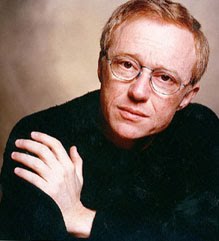
This Tuesday David Grossman's new novel, TO THE END OF THE LAND, goes on sale in the United States, published by Knopf. Grossman is a writer of worldwide critical acclaim and deserves a wider readership in this country (he's a bestseller in Israel, where he lives).

I sold this book to my bookstores months ago, and even though Knopf offered a special promotional allowance to encourage booksellers to take a chance on a long novel from a writer with slow sales in this country (his books were previously published by Farrar, Strauss, & Giroux), it was a struggle to convince stores that this book was something special, a book among books during the busy fall publishing season. And then Nicole Krauss, author of THE HISTORY OF LOVE and the upcoming GREAT HOUSE, supplied a blurb for Grossman's novel.

I myself am not much of a blurb reader. Publishers go to great lengths to secure praise-filled quotes from other established authors and supposedly these endorsements sway booksellers and the public to read a book they might otherwise have overlooked. I almost never read the blurbs myself and barely pay them any attention at all, except that they have become so ubiquitous that I do notice the emptiness of book jackets lacking quotes; they seem naked without the blurb. So for several weeks during the late spring/early summer, a stack of advance reading copies (ARCs) of TO THE END OF THE LAND sat in a stack in my office and I never even noticed the author blurb on the front cover. Then the book media did take note of the blurb.

“Very rarely, a few times in a lifetime, you open a book and when you close it again nothing can ever be the same. Walls have been pulled down, barriers broken, a dimension of feeling, of existence itself, has opened in you that was not there before. To the End of the Land is a book of this magnitude. David Grossman may be the most gifted writer I've ever read; gifted not just because of his imagination, his energy, his originality, but because he has access to the unutterable, because he can look inside a person and discover the unique essence of her humanity. For twenty-six years he has been writing novels about what it means to defend this essence, this unique light, against a world designed to extinguish it. To the End of the Land is his most powerful, shattering, and unflinching story of this defense. To read it is to have yourself taken apart, undone, touched at the place of your own essence; it is to be turned back, as if after a long absence, into a human being.”

Krauss was mocked for her ridiculous rave, with some book industry folks even questioning whether such an over-the-top endorsement would ultimately hurt review and media attention--not to mention readers'--for an otherwise worthy novel. I don't know about the rest of the country, but I can say that in poking fun at the Krauss quote, suddenly my booksellers paid attention to what is a long, literary work dealing with tough subjects in a country Americans seem to typically avoid (at least in literature). So thank you, Nicole Krauss, for letting a book touch at the place of your own essence; while I've never allowed a book to take such liberties with my essence, I admire your courage in admitting how TO THE END OF THE LAND changed your life.

Is this book as good as Krauss suggests? YES. It is a powerful odyssey of family, loss, sacrifice, and war, set in a country that has seen nothing but conflict since its founding. TO THE END OF THE LAND is the story of Ora, a woman estranged from her husband Ilan and the mother of Ofer, a son who unexpectedly re-enlists in the Israeli army when violence erupts between Israel and Palestine. Convinced that she will lose Ofer too, she flees her home, the constant media updates about the violence, and her chatty neighbors, and decides to take a pilgrimage through Galilee. She is not entirely alone on her journey, though; she convinces an old friend, Avram, to join her. Avram, a former POW of the Yom Kippur War who struggles with post-traumatic stress after he was tortured, is not the most obvious--or stable--walking companion, but as they walk across the countryside, Ora tells Avram the story of her family and her son Ofer. She is convinced that Ofer will die while standing guard at his checkpoint, but in telling his story to Avram, she is able to keep her imagined terror in check.

TO THE END OF THE LAND is indeed an incredibly moving book, one that has stuck in my head for months after reading it. Like all Israelis of a certain age, too, Grossman's own children served their stint in the military, and this real-life parallel will increase the media attention for this worthy novel. Indeed, the New York Times Book Review will give TO THE END OF THE LAND its coveted cover review slot next week. I can only hope that readers discover this wonderful novel themselves and possibly even allow it to change their lives...or even write semi-vulgar blurbs praising its essence.

Friday, September 17, 2010

A Loss in Book Land

Earlier this week the book world suffered a major blow when longtime bookseller David Thompson passed away unexpectedly. David worked at Murder By the Book in Houston, one of the country's preeminent mystery bookstores, for 21 years--his entire adult life--and to call him a legend in the industry is not an exaggeration.

I don't know how to comprehend this tragedy. Others knew him better, longer, shared more in common. Still, I miss him. His death seems so terribly unfair. I grieve for him and for the pain felt by his family, friends, and everyone who ever came into contact with him. To know David was to love him.

I knew of "David at Murder By the Book," as my sales reps referred to him in telling me stories, back when I was a buyer at BookPeople and long before I ever met him. Someone so respected and with so much experience--I was shocked when I finally did meet him (in my capacity as a rep for Random House) years later, shocked that David was my age, in his 30's. The book industry by-and-large is a world populated primarily by an old guard of the stalwarts who've run the best stores and the best presses for decades, and then another group of the young booksellers making less than $10 an hour hocking their favorites while figuring out what to do with their lives. David was that rare individual who was experienced but not embittered, young but not looking for "a real job," a man who'd found his love as a 17 year old stocking shelves at a mystery bookstore and made it his life.

Another first impression of David: Gianna and I were escorting one of our New York bosses to stores around Texas, and because we were in Houston we took her to Murder By the Book. At the time, MBTB was a telephone sales account, so I wasn't actually selling to the store and felt a little awkward walking through the door as a stranger...who only lived three blocks away. I needn't have worried. David was in his element and swept all of us into a tour of the store and a discussion of his favorite books, and ours. I wasn't a mystery reader and worried that I would be lost in his world, but the opposite was the case. He accepted everyone, drew out others' passions, and found commonalities to bond people together. In his delightful dorkiness and infectious enthusiasm, it was impossible to feel out of place in his company and in the store. That visit was also special because David and MBTB's new owner McKenna Jordan were about to fly to Scotland to get married, and both of them were giddy about the trip and their obvious love for each other.

When I moved to Houston a year earlier after I accepted the Random House job, I despaired at my disconnection to people in the city; I worked from home but travelled frequently, I don't like organized social gatherings, I didn't have a preexisting group of friends. I had met a few booksellers and eased into a new life straddling my new, isolated life in Houston and my old life in Austin with my friends. David and McKenna unknowingly acted as a bridge between these worlds. They made me feel welcome, they laughed at the same things, they worried about the same issues (to be in your 30's and looking at the rapid changes in the industry and ponder your chances for a career in this business--it's a daunting vision of the future). I counted them as friends. I loved giving David a hard time--he and McKenna joined Gianna and me for an Astros game earlier this year and David insisted that McKenna bring a glove to protect him from foul balls--and he loved the exchanges.

I have never met a more passionate bookseller than David Thompson. He possessed an innocence in his boyish enthusiasm for what he loved--books, authors, and sharing the joy of reading--that was entirely unique and beautiful. David was supposed to attend a dinner the night of his death, a dinner I was hosting along with a group of people representing Other Press, and I'd specifically wanted him there because everyone in the industry needed to know him and know that the written word had such passionate advocates. He was loved by his customers, he was loved by his sales reps, he was loved by the publicists with whom he booked signings, he was loved by the authors, he was loved by his fellow booksellers, and he was loved by family and friends. I am a better person, a better book rep, and a better reader because I knew David Thompson, even if only for a couple of years. I've missed him every day this week, and I don't anticipate the longing to see an email pop up in my inbox or hear his voice on my phone to ease any time soon.

Read a mystery in David's memory this weekend and drink a margarita. He would have liked that.