Showing posts with label memoir. Show all posts

Wednesday, March 18, 2015

GIRL IN THE DARK by Anna Lyndsey

Look, I'm pale. The sun gives me headaches and I burn extremely easily. I'm also hypersensitive to bad indoor lighting and even the slightest flicker will trigger a migraine. However, because I am able to walk outside, because I can sit in a room with three lights illuminating a room otherwise cast in shadow, and because I am currently sitting here and looking at the illuminated screen of my laptop, I am more fortunate than Anna Lyndsey.

Girl in the Dark is Lyndsey's trance-like memoir of her rare medical condition and her life. A 20-something, she was working in an office one day when she noticed that her computer monitor brightness was hurting her. The condition progressed over the course of weeks to become sunlight, lamp light, dim light, and then all night entirely. There's photosensitivity and then there's Anna Lyndsey. Her career is put on hold, her pending marriage becomes a huge question mark, and the need for complete dark becomes an all-consuming goal. Lyndsey's life is reduced to blacking out an upstairs room in her home and staying there for days and days and days. You know those prison shows where solitary confinement in The Hole makes people go mad? That's her world, except
The view from Anna's room.
(Artist's conception)
(Yes, it's just a black box)
without the crime and punishment element.

In the book, Lyndsey lyrically describes her condition and also her attempts to find others like her, to find help that doesn't include a doctor saying something clueless like "just come down to the hospital and we'll examine you" when she can't go outside her room, to find ways to keep from going insane. There's not a sense of time in the book because there is no time when you don't have sun and moon, day and night. She can't see a clock. Clocks require light to read. Oh, and she can't read. She listens to audiobooks. She longs for visitors and dreads the awkwardness of visits. She plays games in her head to keep from cracking. If "The Yellow Wallpaper" were set in a moodier locale, it might be Girl in the Dark.

If you were stuck in pitch black for
days on end, wouldn't you start to
worry that you'd end up looking like
this? Just me? Okay. 
I admit that I'm crazy for this book.  Lyndsey is resilient despite pain, seemingly hopeless situations, and struggles that wouldn't even occur to most people. She's an activist from a second floor room without contact with the outside world. She's reduced to the most basic functions, but still keeps fighting for her quality of life, and writing about it eloquently. There's a section of the book when her photosensitivity eases a bit and she's able to go out into her garden for short periods of time on dark nights. This reprieve is threatened, though, with the city announces that new, more efficient, brighter light bulbs will be installed in all of the area street lights. The new lights would imprison her. It's the drama of a routine, mundane change amplified to life-altering magnitude that makes Girl in the Dark a wonder.

Tuesday, June 10, 2014

J.D. Salinger on Line One

Okay, so I was preparing for sales conference in February and there was a book on the list called My Salinger Year that was a priority. "Priority"=everyone must read at least an excerpt. The thing is that I HATE reading excerpts of books. I am a book monogamist and if I start something, there's about a 95% chance that I will see the book through to the end. So I'm looking at this manuscript and I'm feeling a bit of reluctance because here's the thing: I don't really love J.D. Salinger. I started asking my colleagues. "Is it about Salinger?" "Do I have to like Salinger to like it?" "What if I think The Catcher in the Rye is stupid?*" Ultimately though, I know that it's my job to read books that I might not personally like. One of the great joys of my job, is the great discovery, and even more special is the book that turns out to be great when it defies my preconceived notions. Don't judge a book by its title, it turns out.

This is a Dictaphone.
It is not considered modern technology.
Joanna Rakoff's memoir My Salinger Year is simply a joyful, pleasurable, memorable reading experience. Fresh out of college and wanting to be a writer, Joanna takes a job as an assistant at a literary agency. For those not in the book business, pretty much if you want to get a publishing deal, you first have to find an agent. This agency is an old house of some repute, and Joanna is excited to dive into work. She's so excited, in fact, that her first day happens to be the day of a blizzard and she's the only person who shows up for work. It's an auspicious start. Also, though it's 1996, the office still uses typewriters and Dictaphones. I was in college in 1996 and I know for a fact that computers and email were common and the standard for communicating and word processing. And then there's the agency's most famous client, Jerry.
Joanna Smith Rakoff
No longer an agent's assistant.

Jerry, of course, is famous recluse J.D. Salinger, and 1996 happened to be a significant year for Salinger and his agent and his agent's assistant. Joanna answers the phone and transcribes notes and opens the many, many letters that arrive for Salinger from his fans. She is supposed to reply with a standard letter, but she's a writer and curious about the letter writers' stories and violates the form letter policy. Also, Jerry? He's hard of hearing and screams into the phone and never actually manages to call Joanna by her actual name. Joanna, too, hasn't actually read Salinger. Can you see the appeal of this book?

Jerry
Rakoff writes a fun, interesting memoir that captures this one year in her life. I like her writing, and I like that the book doesn't try to do too much. It's the story of a newly independent woman making her way into the working world while trying to figure out her personal life and who she wants to be as an adult. These are Salinger-esque themes, and to some extent universal. She's not a phony. It's also a book about the publishing industry and what it's like to work behind the scenes with one of the biggest writers of the 20th Century. My Salinger Year takes the legend of J.D. Salinger and presents Jerry, the guy who calls in the talk about royalties; it's a humanizing book for both the author Salinger and the author Rakoff. This book is intelligent, wise, effervescent, a really good read. Thank goodness for assigned reading for compelling me to dive in.

*For the record, I did like Franny and Zooey and Raise High the Roof, Carpenters and Seymour: An Introduction. I think I read The Catcher in the Rye too late; as a 27 year old, Holden Caulfield struck me as a whiny, spoiled, white guy with what's referred to these days as "first world problems" (a term I also hate).

Friday, March 22, 2013

What You're Not Reading Day 1


I have really terrible news; we’ve decided to post a blog every day for the next few months. We are shooting for 100 straight days of book blogging. We will finish these last ten days of March writing about books you aren’t reading but should be. No, not the Bible or Gone Girl, but other books we loved that we know (psychically) you aren’t reading. In fact that’s our new thing: we are book psychics, tell your friends.

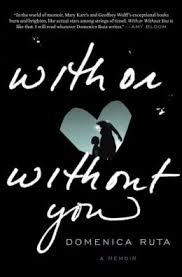
See, I know for a fact that you aren’t reading With or Without You by Domenica Ruta. 
It’s okay, I almost missed the chance too, but you can learn from my near catastrophic mistake.


In the United States, over ten million books were published in 2012 (source: absolutely none, I totally made this statistic up), so I get it can be overwhelming (that’s why following a good book blog is important; we highly recommend looking for one, as clearly this isn’t it). Memoirs in particular are over-published so it’s certainly easy to miss a good one, and more importantly it’s too easy to buy a crappy one. I owe our pal Toni H. (trust me she doesn’t want her entire name in print on this blog, it’s too late for Liz and me, but not Toni) a big thank you for passing an ARC to me a few months ago insisting that this memoir was up my alley. I looked at it, saw it said nothing about women in prison on the cover, so I tossed it into the pile of books not about women in prison. After another nudge from Toni I picked it back up and tore through it.

With or Without You is a rough ride. You want more than anything for Ruta’s mother Kathi to get her shit together. Sometimes she comes close. Sometimes she is a loving (ish), protective mother and maybe things are going to be okay. But then inevitably the addiction and dysfunction take over and her mother returns to drugs and alcohol, in fact shares with her daughter. (It’s educational.) This memoir, while certainly devastating, has a couple of laugh out loud passages that only a book about addiction can deliver.  Kathi takes a crow bar to the windshield of an enemy. She swings and swings, and huffs and puffs, but man, the windshield will not break. She manages a crack here and there sure, but there’s no real satisfaction of a completely smashed in crumbled windshield. Finally, totally exhausted, completely embarrassed, she kind of shrugs and gives up as her daughter looks on. Awkward.
Domenica Ruta

With or Without You is riveting and much of that is due to the pace and the truly excellent writing. We’ve heard variations of this story--heart-wrenching memoirs of mothers and daughters. But where most memoirs fall short, and I really do mean most, is the writing. We all think we have a story to tell but if you can’t tell it in an original and eloquent way, it will never be able to sit on a shelf with the likes of The Liars Club, All Over but the Shouting or The Kiss.  Ruta’s memoir will fit quite nicely with those classics. (Liz’s memoir will live in the leaky part of my garage.)

I suspect this book will find its audience and its real life in paperback when book clubs pick it up, much in the same way The Glass Castle did.  I hope so anyway, but if you are like me and haven’t read a truly good memoir in a while and don’t want to wait a year for the paperback, this hardcover is certainly worth the cash.  


Tuesday, March 5, 2013

Surviving the Tsunami: WAVE by Sonali Deraniyagala

When the tsunami hit Sri Lanka in 2004, Sonali Deraniyagala was on vacation with her family. She, her husband, and her two sons were staying in a resort, about to head down to the beach. Realizing that something was wrong with the water that didn't stop at the beach, they raced inland on foot, and then jumped into a jeep. She didn't have time to alert her parents, staying in the room next door. Unable to outrun the water, the jeep was flipped and Sonali lost her grip on her boys and husband in the debris and flood. When she woke, she found herself in the midst of a hellish landscape, alone.

Sonali Deraniyagala
Wave is Sonali Deraniyagala's horrifying, gripping, unflinching memoir of what happened the day the tsunami hit and what it's like to lose her entire family to one of the worst natural disasters in history. Somehow she survived the tidal wave, but then comes the task of rebuilding a life she's not even sure she wants to live anymore. Wave isn't just another inspirational memoir about how a person experiences a trial and comes out the other end better for the experience. Let's face it, Deraniyagala's life is never going to be "normal" again in the way it was normal before the tsunami. She spent days looking for the bodies of her lost family. The book is a chronicle of resilience and struggle, though, and just by placing a foot in front of the other she shows her courage.

I read Wave months ago, in an afternoon and as preparation for a sales conference. It's a short book and I was reading about twenty books in the span of about two weeks. Nonetheless, this little book knocked me on my ass. It's incredibly powerful and offers room for some interesting conversations. Would you choose to continue living when your loved ones died? How would you cope with the survivor guilt? How do you sleep at night when another freak incident can knock you down again, at any moment? Right now the news is splattered with the man lost in the sinkhole in Florida. Imagine the devastation of a tragedy 250,000 times greater. I can't get this story out of my head. Sonali Deraniyagala's story is arguably the most incredible you will read this year.
The path of the 2004 tsunami. The earthquake creating the wave was the
third largest ever recorded. Sri Lanka, for those who haven't looked at
a map in awhile, is the island off the southeastern tip of India. About a quarter
of a million people died in the wave, with little or no warning of its approach.

Saturday, January 26, 2013

New Year, New 30 Day Book Challenge, Day 24


Day 24: A Book You Wish More People Had Read

Gianna:

In 1994, I was living in Florida when I read a stunning review of Lucy Grealy’s memoir, Autobiography of a Face.  I finished the review, immediately went to a bookstore, and purchased a copy. It must have been a Sunday because I returned home and read the book that afternoon and into the night.

Lucy Grealy was diagnosed with a rare bone cancer at the age of nine. The ensuing surgery would ultimately take half of her jaw, disfiguring her face. As the story continues, she encounters the worse than average teenage years of insecurity, taunting by boys (as she gets older the side of her face begins to sink in), plus the guilt of her illness’s financial burden on the large family.  She would grow her hair long in an effort to conceal her face as much as possible, rarely making eye contact. 

While I suppose this could have easily become one of numerous incredibly depressing memoirs, it defies that definition. It really is the story of how Grealy found salvation while at Sarah Lawrence College. She found poetry and a community.

Grealy would eventually find a surgeon that has success (after dozens of surgeries over her lifetime), but that too comes with mixed emotions.

After you read Autobiography of a Face, check out Ann Patchett’s Truth & Beauty which is about her friendship with Lucy Grealy. It will break your heart, and who doesn’t need that?


Liz:

Once upon a time, I took a whole lot of religion classes in college. I know! The next thing you know, I'll confess to being the Rotary Club Sweetheart in high school (....I guess I'm feeling a bit confessional tonight). Anyway, I was an English and History major, but the religion courses were fascinating and great blends of both literature and history. One of the better classes I took was on gnosticism, and one of the best books from that class was The Gnostic Gospels by Elaine Pagels.
The Nag Hammadi codices found in 1945.

Here's the thing: if you're going to be a member of an organization, you should know the history of that organization. If you are going to be a Christian, you should know the history of your church.  Princeton professor Elaine Pagels should be required reading for members of the world's largest religion. In 1945, some farmers in Egypt found a clay jar filled with books dating back to the 2nd Century, believed to be buried before they were destroyed by church leaders.

Elaine Pagels
 In 1975, the texts were made public, and Pagels? Elaine Pagels is one of the go-to authorities on the Nag Hammadi find and the early versions of the Church that existed before leaders suppressed fringe groups and versions of Jesus's life that didn't follow the approved script. The Gnostic Gospels reveals an early church that doesn't closely resemble what it looks like today. Ever hear of The Gospel of Thomas? It exists. The Gospel of Mary Magdalene? It exists too. Why isn't it in the Bible? Excellent question.

The Gnostic Gospels isn't some boring, jargon-laden, academic text. Elaine Pagels is a good writer and her book made the Modern Library's list of 100 best nonfiction books of the 20th Century. I don't understand blind faith. I do understand learning as much as possible about the power structures that govern our culture. I wish more people would read this book.