Friday, November 6, 2015

Knopf 100--Day 19

69.  In Sons of Mississippi Paul Hendrickson looks to identify and interview the men in an iconic photo taken just before the integration of the University of Mississippi in 1962. The men in the photo (which appears as the cover of the book) don't know that their lives are about to change, that the photo would land on the cover of Life Magazine. As the years pass they would of course find themselves on the wrong side of history which would be documented in this photograph forever. What happened to these men? What about their children, their grandchildren? I thought about this photograph a lot this summer as marriage equality became the law of the land; what would become of those people, what will their children think in thirty years (or five)? This is one of the best social history books I've ever read, as good as Jonathan Kozol's Savage Inequalities, Barbara Ehrenreich's Nickel and Dimed, or The Other America by Michael Harrington.


70.  Maggie O'Farrell writes smart, clever, interesting books often about families in crisis. Instructions for a Heatwave, set in 1975 London, finds the adult children of Robert Riordan looking for him after he sets out for an errand one morning and doesn't return. As the novels moves forward we learn that each member of the family is hiding something, holding shame, or
possibly not being who they appear to be. I devoured this novel in a day, could not put it down to save my life. I love when a novel captivates you to the point where you not only can't put the book down, but then move on to the author's previous books - which is exactly what I did. O'Farrell has not disappointed me.

71.  Breaking Clean is a really lovely memoir. Blunt was raised on a Montana in the 1950's and
1960's, sans indoor plumbing. She went to school in a one room schoolhouse, and upon graduating high school was expected to marry and become a traditional ranch wife and mother. After over a decade of marriage and three children, Blunt summons the courage to walk away from her marriage, from the ranching life she loves, to go to college and study poetry. She searches and finds her authentic self.


72.  I wanted to include this completely fantastic collection of stories in this group because it's now occurred to me that this post could use some levity, some humor, which these stories have in spades, though they do explore the underbelly of love, and the sadness of it as well--I Am an Executioner: Love Stories by Rajesh Parameswaran (spelled by memory folks). Love stories, yes, but also our love of power. Love and power. The opening story, “The Infamous Bengal Ming,” is narrated by a tiger who is absolutely lovesick over the death of his trainer who he accidentally mauled to death. This happens in Liz's relationship with her cat, Zorro, quite a bit; it's been documented here on the blog several times. These stories are truly original, and this was my favorite collection of 2012. If you can, try to read this in just a few sittings because the stories really connect on different levels. Tick tock Mr. Parameswaran (totally by memory) I am waiting for another book.


Thursday, November 5, 2015

Knopf 100--Day 18

Someone who knows Gianna, please remind her to swing by my house to bring in my trash cans. Thanks.

65. Seating Arrangements by Maggie Shipstead, originally published in 2012. Weddings are a fictional, frictional gold mine, and what's not to love about a novel in which the bride is seven months pregnant? Think of a more literary Father of the Bride, with a pregnant bride, a TON of long held grudges, some lusting among the bridal party members, and a rogue lobster. This is the wedding I'd actually want to attend. Shipstead is a talented writer and an up and coming bestseller generator (if there's any justice at all in the world).

66. Americanah by Chimamanda Ngozi Adichie, originally published in 2013. I was obsessed with Americanah when it came out and am still obsessed with Chimamanda Adichie. This woman is going to win all of the awards. In thirty years she will be a Nobel Prize winner. I'm calling it now. Americanah won the National Book Critics Circle Award for Fiction and it really should have won the Pulitzer (because it's a thousand times better than The Goldfinch). In the book, a young couple depart their native Nigeria. Ifemelu comes to the United States and finds some success in academia and as a commentator on the nation from the outsider's perspective. Obinze can't get into the US to join her, so he ends up going to England as an undocumented worker, but finds success. Fifteen years later they both end up returning to Nigeria, changed, but hopeful in rekindling their passion for each other and their homeland.

67. Peace by Richard Bausch, originally published in 2008. Like Jim Shepard, Richard Bausch is a super talented writer that not enough people read. I love this short novel of his, Peace. It's World War II and three US soldiers are sent on a mission to scout out what's on the other side of a hill. Their Italian guide can't be trusted and it turns out that the hill is really a mountain. It's cold and rainy and miserable and war is hell. This is the kind of novel that sticks in your head and makes you think "I should read everything this guy writes," and yes, you should.

68. Half the Sky by Nicholas Kristof and Sheryl WuDunn, originally published in 2009. Pulitzer Prize winning journalists Kristof and WuDunn tell the stories of women around the world in their book Half the Sky, which was made into a PBS miniseries. The stories are sometimes grim, sad, and emotionally devastating, but they also offer hope. Imagine the strength of things like the economy, or education, or politics, or human rights, if half the world's population were treated equally with the other half. That's the mission here, and Half the Sky is one of the most important calls to action of the last decade.


Wednesday, November 4, 2015

Knopf 100--Day 17

I just realized that Gianna picked Plainsong yesterday, which I'd picked on Day 2 or so, so you need an extra pick there, La Morte.

61. Acts of Faith by Philip Caputo, originally published in 2005. I think people have forgotten about this book and that's a cryin' shame. Acts of Faith is pure storytelling genius, but it's also the book that made the Sudan crisis real for me. That's the power of great fiction, right? Warlords, aid workers, a pilot who goes from flying in supplies to smuggling in arms, and the missionaries--the characters are unforgettable, as is the setting.

62. Baseball by Ken Burns and Geoffrey C Ward, originally published in 1994. It should be noted that all of those amazing Ken Burns documentary series on PBS have beautiful and well-written companion books, and I could have picked The Civil War or The National Parks or Jazz for this spot. Taken together, they are a pictorial, encyclopedic history of the defining elements of American culture. I chose Baseball because I'm already missing the game since the World Series ended a few days ago, and because Burns added "an extra inning" updating the book a couple of years ago and I happened to catch his publicity tour then in both Washington, DC, and Baltimore. I love baseball and I love this book/series. Burns covers the whole history of the game and its biggest personalities and players, from Rogers Hornsby to Babe Ruth to Jackie Robinson to a hell of a lot of stupid Yankees I hate to the game and players of today.

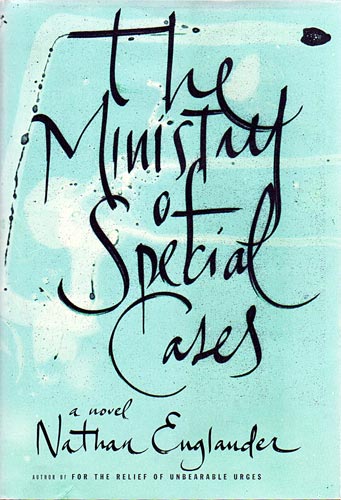
63. The Ministry of Special Cases by Nathan Englander, originally published in 2007. Nathan Englander is one of those writers who needs to write more because his books are always worth the time (all three of them). Like Acts of Faith, The Ministry of Special Cases was a novel that brought to life a specific time and place in my mind's eye. This novel is set during Argentina's Dirty War and swirls around a Jewish family in Buenos Aires. When their son becomes one of the disappeared (and this was a time when anti-government supporters were flown up in helicopters and then pushed it to fall to their deaths in the river below), a father and mother desperately seek relief and aid from the Ministry of Special Cases. It's a Kafka-esque hell of bureaucracy and futility. Fun times!

64. The Dog Stars by Peter Heller, originally published in 2012. I have a colleague who loves this book so much that she still gets emotional when talking about it and she keeps copies at her desk to give to anyone who happens by who hasn't yet read it. Peter Heller wrote nonfiction for years for journals like National Geographic and I feel pretty confident in saying that he writes about nature better than any other fiction writer out there right now. Heller's Colorado setting is a land of beauty, peace, hope, peril, and redemption. The Dog Stars is a post-apocalyptic story of a pilot who manages to survive a killer infection. He's alone in a Denver suburb except for the companionship of a burly, surly man he doesn't particularly like, and his dog. He hunts, he takes his plane out to look for other survivors, and he struggles to keep going. The Dog Stars thoughtfully questions the value of life and what a person needs to keep going when all hope seems lost.


Tuesday, November 3, 2015

Knopf 100--Day 16


57. If you asked twenty people at Random House to name their top twenty favorite books, I bet over half them place Plainsong by Kent Haruf on that list. It's a deceptively simple novel about the fictional town of Holt, Colorado, and it’s inhabitants. Through a few characters--Maggie, Victoria and the McPheron brothers, --Haruf moves you through this small town. Occasionally you will hear someone describe reading a book and becoming so engrossed that you forget it’s fiction, or you think just for a moment that you know the characters. That’s what Kent Haruf is able to do. He transports you to this lovely town and so expertly writes engaging characters, that you absolutely lose yourself. Plainsong, by the way, is actually a trilogy; it is followed by the Eventide, and Benediction. I envy anyone who hasn't read this trilogy yet, you're in for a really wonderful treat. 

58. "Paper Moon is one of the best movies ever made!" I once had a thirty second conversation with Peter Bogdanovich and that's what I chose to say. I think he was pretty impressed that I didn't shower praise on the obvious masterpiece, The Last Picture Show. Anyway, don't let that play over and over in your head, it's cool. Bogdanovich had a pretty frustrating career as a director actually; I like to blame it on his very odd life choices but we aren't going to talk about that. We are going to talk about the excellent book, Who The Hell's in It: Portraits and Conversations (the Ballantine paperback edition has a slightly different subtitle of Conversations with Hollywood's Legendary Actors). This book was a follow up to conversations with directors, but Bogdanovitch studied under Stella Adler (she's in the book) and was a reporter before he was an actor or a director, so this book really is perfect. Who the hell's in the book? Everyone. Marilyn Monroe, Charlie Chaplin, Lillian Gish, Sidney Poitier, River Phoenix, John Cassavetes, and Audrey Hepburn. I mean, it's a huge list, that's not even half. This book is an absolute must have for movie buffs. If you haven't seen Paper Moon...it's one of the best movies ever made!


59. What do Rita Dove, Charles Wright, Mark Strand, Jorie Graham, John Irving, and James Tate have in common? That's right! They're all Pulitzer Prize winning poets who were taught by Donald Justice. Well, okay, if you're going to be picky, John Irving isn't a Pulitzer Prize winning poet but he was taught by Justice and clearly adored him (read Hotel New Hampshire). Where to start with Donald Justice is easy--start anywhere: Collected Poems (2004) which was nominated for the National Book Award,  New and Collected Poems (1996) which was nominated for Pulitzer. Justice, by the way, would win his Pulitzer in 1980; you think he's going to let everyone else collect one?  Well, he probably didn't give much thought to these things, he was quiet, thoughtful, and incredibly modest. I will end with one of my favorite Justice poems, "On the Death of Friends in Childhood" which can be found in Collected Poems 


We shall not ever meet them bearded in heaven, 
Nor sunning themselves among the bald of hell; 
If anywhere, in the deserted schoolyard at twilight, 
Forming a ring, perhaps, or joining hands 
In games whose very names we have forgotten. 
Come, memory, let us seek them there in the shadows.


60. Nell Freudenberger came on the writing scene at the ripe old age of 25. She published a phenomenal book of short stories called Lucky Girls, which I loved. She continues the same theme of clashing cultures in her debut novel, The Newlyweds to great success. Amina, a  young woman from Bangladesh, searches for a mate on an international dating website where she meets a lonely man a decade older who pines for a family of his own. An arranged marriage of sorts follows and while this could easily fall into some dead end formula, Freudenberger nails this on every level. 


Monday, November 2, 2015

Knopf 100--Day 15

It seems I'm in a dark book mood today.


53. Tokyo Year Zero by David Peace, originally published in 2007. David Peace is a great mystery writer and this mystery is unlike anything else I've read. It's set the year after World War II ended, in a broken Japan. The country is bankrupt which means that the Tokyo police force is bankrupt. When a killer unleashes horrors on the city, a detective is hot on his trail. What's special, though, is Peace's stream of consciousness writing that captures the underworld terror of the city and its war worn residents. Things like the nagging itch of lice become focal points for the characters and reader.

54. American Prometheus by Kai Bird and Martin J. Sherwin, originally published in 2005. I'm admittedly obsessed with atomic culture and the historic impact of the bomb on the 20th Century. That culture all begins with J. Robert Oppenheimer, the subject of Bird and Sherwin's award winning biography American Prometheus. Here is Oppenheimer's story, from Communist sympathizer to father of the atomic bomb to moral conscience of the nuclear era. Oppenheimer is fascinating because of his scientific genius and ability to lead the Manhattan Project, but he's also intriguing for his affairs, political beliefs, and how the people who revered him after the war ultimately destroyed him several years later. Yes Gianna, I do have a crush on Oppenheimer. I'm not ashamed.

55. In the Cut by Susanna Moore, originally published in 1995. Ooh, creepy, gothic, erotic, serial killer novel! I have to include this book on the list, and I need to grab it before Gianna snatches it away from me. When a woman is murdered in her neighborhood, Franny, an academic with a love of precise language, becomes obsessed with the crime and her darker desires. She begins an affair with the detective on the case, and this book becomes a twist of language, sex, risky behaviors, and distrust.

56. All the Pretty Horses by Cormac McCarthy, originally published in 1992. All the Pretty Horses was my first experience reading Cormac McCarthy, when I "borrowed" a copy off my boyfriend's shelf. I don't know what I was expecting that night, but I doubt I expected to be so sucked into a book that I ignored everything else for the rest of the evening. The story follows John Grady Cole, a 16 year-old kid who, spurred by the death of his grandfather, sets off on horseback. Accompanied by a couple of friends, the boys venture into Mexico and encounter love, bandits, and the desert. This novel deserved the National Book Award that it won.


Sunday, November 1, 2015

Knopf 100--Day 14

49. To the End of the Land by David Grossman, originally published in 2010. To the End of the Land is another example of Knopf seeking out and publishing novels from overseas, this time Israel. Addressing the threat of violence in that country that's combined with compulsory military service Grossman's story is one of grief, fear, and love. Ora is thrown into a tailspin when her son decides to reenlist in the army just as anti-Israeli tensions are flaring up again. Convinced that the worst is going to occur, she sets off on a pilgrimage, walking across the country. Joining her on the journey is an old friend and former lover, Avram, the man who as a soldier was captured and held as a POW years earlier during the Yom Kippur War. Avram is damaged by the experience. Walking together, they try to work through the fears in their heads and the horrors of the past. This is a great read, so if you own a copy and know Gianna, you might want to hid your book. Her recent posts suggest that thievery is her favorite pastime.

50. When the Emperor was Divine by Julie Otsuka, originally published in 2002. Julie Otsuka is one of those holy shit writers that doesn't waste a word but still manages to knock you out with a 160 page novel. Emperor was her first book and can/should be read in one sitting, then followed by another book, The Buddha in the Attic (equally short, equally incredible). When the Emperor was Divine describes the story of a Japanese-American woman living in Berkeley when she sees fliers giving instructions for people of Japanese descent to report to internment camps. Her husband is suspected of spying for Japan and she and her children are relocated to the rarely discussed US concentration camps set up during World War II. Otsuka's writing about the camps is impeccable.

51. The Children's Book by A.S. Byatt, originally published in 2009. With The Children's Book, Booker Prize-winning author A.S. Byatt has written a novel set during one of my favorite periods, the end of Edwardian England and the time during World War I. I'm talking to you, Downton Abbey fans. There are a ton of characters here, but at the center is Olive Wellwood, the matriarch of a large family and writer of children's books. She writes one book for each of her seven offspring. Into the mix comes a runaway named Phillip; think Dickens meets J.M. Barrie to know that this twist was a guarantee. Anyway, through the stories of her children and the stories created for her children we get a picture of England as a whole.


52. The Sibley Guide to Birds of North America by David Allen Sibley, originally published in 2000. It's not often that a revolutionary field guide comes along. Sibley is the Audubon of our lives, though, and his birding field guide has become the gold standard for birdwatchers. At the time of its publication I'd just started dating an avid birdwatcher, and I quickly became familiar with the beautifully painted birds in its pages. I also became too familiar with its heft as I served as field guide pack mule on our many jaunts to birding locations. Romance at the waste water treatment facility--l'amore!


Saturday, October 31, 2015

Knopf 100--Day 13


45. The Senator’s Wife is a really clever novel with some smart plot twists along the way. It’s the story of the wife of a powerful and philandering senator. His cheating is an open secret in Washington, but the final straw for the wife comes when he sleeps with a friend of their daughters. They separate but don’t divorce. She is unable to move on from him and they eventually begin to have an affair of their own. They carry on like this until a plot twist puts the wife in the position of authority, which changes both of their lives.

46. We’ve written and fawned over Going Clear a few times already; it made my best of list last year. Even if you’ve seen the HBO documentary that is based on the book, make time in your schedule to read it. While it’s easy to write off followers of Scientology as people who have been duped by a really odd religion, what Larry Wright gets so write in this book is not only the detailed history of Hubbard and Scientology, but the complete fraud the religion really is. Leah Remini, who left Scientology last yea,r has a memoir that's just out, and oh, how the shit will hit the fan.

47. Germaine Greer took a bit of heat after her memoir Daddy, We Hardly Knew You was published. Critics would of course use this memoir as the reason she became such a pain in the ass feminist...daddy issues. She attempts to unearth the man she never really knew, a father who was distant, cold, and well…not all that interesting. While reading, you can’t help but hope she and her father find something to bond over, are able to repair the past and make amends, but that’s a fool's game because Greer gives it all away on the first page when she makes it pretty clear, the father she pines for would simply never be.


48. What do you get when you introduce a strange dude with a porn addiction to a housewife stuck in horrible marriage? That’s right, you get a dark, funny, really smart, completely original, novel by one of the best writers working today, A.L. Kennedy. Original Bliss was the first book I read by Kennedy and to be honest, it was a bit tough to get into; at that time I hadn’t read anything like it. This is, in the end, a really sweet love story about two lonely people living on the fringes of society.